
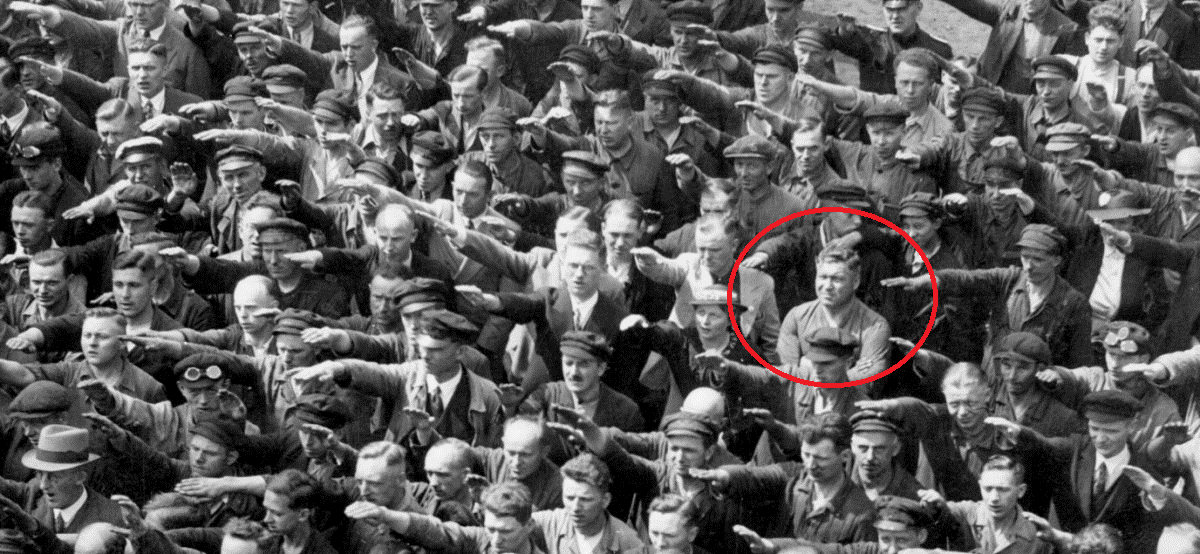
[The Lone German, 1936]
In the examples that follow, great evil runs rampant through society. This evil stems from tyrannical ideologies that silence dissenting voices and demand absolute conformity. Yet in each scenario, at least one person makes a courageous stand against the tide, despite tremendous pressure to conform. Those who make such stands are always the heroes.
So what makes a hero?
To answer this, we will examine two case studies of heroism in the face of tyranny before extracting the conditions that separate those who conform from those who call forth their heroism.
Case Study 1 – The Nazi Salute
In a sea of men and women giving the Nazi salute to Hitler in 1936, one man refused to do so. August Landmesser, the Lone German, had already been expelled from the Nazi Party for becoming engaged to a Jewish woman, Irma Eckler. At the time this photograph was taken, they had a one-year-old daughter together and were living in defiance of the Nuremberg Laws that forbade their relationship.
The following year, Landmesser was arrested for attempting to flee to Denmark with his family. Though initially acquitted, he was re-arrested in 1938 and imprisoned for nearly three years. Irma was also arrested, gave birth to their second daughter in prison, and was eventually murdered at Bernburg Euthanasia Centre in 1942. Landmesser never saw his wife or children again—he was killed in action in Croatia in 1944.
Most people followed the rules to avoid such a fate. They did not marry Jews. They did not speak to Jews. They supported the idea of creating a utopia for the ‘chosen, God-given race’ of Germans. They sold out the life they wanted to live and chose the prison of conformity.
Case Study 2 – The 1994 Rwandan Genocide
In 1994, a carefully planned genocide was orchestrated by the government and carried out by the people of Rwanda. If you were a Hutu, you might have killed your neighbour out of fear for your own life. If you were a Tutsi, you were hunted like prey.
You were labelled ‘the enemy,’ giving ordinary people an excuse to hunt you down. The reason? An identity card that read ‘Tutsi’. You were barricaded in cities like Kigali with no escape route, no foreign intervention, no national aid. You could not go to the shops for food; if you stepped foot outside your house, you would not make it back. Yet you were not safe inside either, for the militia knew which houses contained ‘the enemy.’
There was to be no mercy for anyone. Babies, women, and the elderly were not exempt. This was the message every Hutu heard on the radio—’the voice of death,’ as one survivor called it. The genocide lasted 100 days and killed nearly one million people.
Like the Germans who saluted Hitler, ordinary Hutus sold out their neighbours because they believed themselves to be the ‘chosen ones.’ They failed to see that the same evil ideology that made them executioners today could make them victims tomorrow.
What might we learn about the Fallen State of Man?
1. Fear can quickly turn a well-intentioned person to betray their morals and turn to the dark side.
2. False ideologies - such as related to ‘the chosen ones’ - eradicate any essence of empathy.
3. False ideologies decrease the value of human life, making atrocity possible.
On the other hand, what values underpin the Hero?
1. Individual sovereignty: The conviction that no other human being owns them—that they own their own life
2. Foresight and sacrifice: The ability to see that if they do not do something now, things will only get worse in the future
3. Love and empathy: The willingness to put oneself in another person’s shoes
How might we practice heroism and participate in making our world free again?
This is where the story of Jesus comes into play.
In the face of tyranny, Jesus stood up to the religious authorities of his day. When they wanted to stone a woman for adultery, he said no—let the one without sin cast the first stone. When they condemned healing on the Sabbath, he said the Sabbath was made for man, not man for the Sabbath. He challenged rules that valued tradition over human dignity.
Jesus challenged the rules and customs of his day that made no sense or added no value to society. This is the same thing that the heroes above have done.
To participate in the heroic story isn’t to bow to those who set themselves up as gods over man. It is to embody Christ’s example and stand up for what is just, providing every person with the opportunity to live a free life.